Inhaltsverzeichnis
Various definitions
 review translation
Roadworthiness
Definition of the values:
0=No information
1=no restrictions
2=not roadworthy
3=not suitable for night-time driving
5=Depends on the core thickness and finish
Not suitable for use in road traffic: For spectacles manufactured for use at close and intermediate distances, the optician must inform the customer that they are “not suitable for use in road traffic”. For spectacle lenses whose design falls under this category, the manufacturer must provide the optician with information indicating this restriction on use.
For spectacle lenses whose tint does not ensure traffic light recognition in accordance with DIN EN ISO 14880, the manufacturer must provide the optician with information indicating this restriction on use.
Not suitable for night driving. For spectacles whose lenses have a light reduction of over 25%, the optician must inform the customer that they are „not suitable for night driving“. For spectacle lenses with a light reduction of over 25% (in accordance with DIN EN ISO 14889), the manufacturer must provide the optician with information indicating this restriction on use.
Cylindrical effect
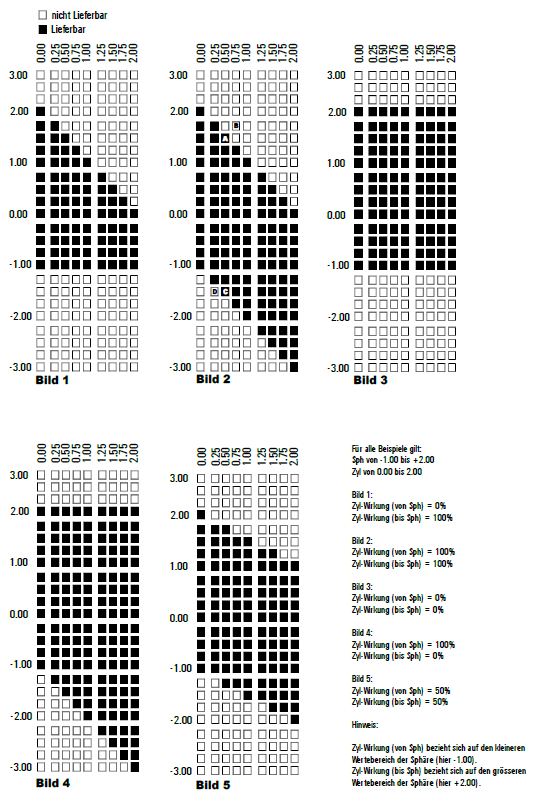
In the LensRange file.Dat, the ‘Cylinder Effect’ fields have been defined. These define the effect of the cylinder on the availability of the base lens. There are some examples of this in the appendix.
All five examples have the following supply range:
Sph -1.00 to +2.00
Cyl 0.00 to 2.00
Although the supply range is the same in all graphs, the actual supply ranges differ in detail (the actual available Sph/Cyl options are the black squares in the supply range grid). All the options shown in the five graphs occur in practice!
A simple way to illustrate this is to specify a percentage factor by which the cylinder influences the strongest principal axis. The percentage factor is specified for both the lowest (‘Cyl effect from’ to ‘Strongest principal axis from’) and the highest (‘Cyl effect to’ to ‘Strongest principal axis to’) values of the principal axes. In this context, the smallest value is determined using a number line. (-9.00 is smaller than -2.00, +2.00 is smaller than +5.00)
The formula for the resulting principal axis is therefore: HS=Sph+Cyl*Power%
Example 1: (Cyl. effect on “st. HS from”=0% Cyl. effect on “st. HS to”=100%) In Figure 1, the cylinder is taken into account in the upper range and not taken into account in the lower range. There are the typical stair-step effects in the upper region (which is in the positive range) and in the lower region (which is in the negative range).
Example 2: (Cyl. effect on “st. HS from”=100% Cyl. effect on “st. HS to”=100%) The cylinder has a 100% effect in both cases. The value “Sph+1.50/Cyl0.50” (mark A) is available, as the resulting strongest principal power +2.00 (+1.50+0.50) falls within the specified supply range. The value “Sph+1.75/Cyl0.75” (mark B) is not available. The resulting strongest principal axis +2.50 (+1.75+0.75) is higher than the maximum value of the specified Sph (+2.00). The value “Sph-1.50/Cyl0.50” (mark C) is available, as the resulting strongest principal axis of -1.00 (-1.50+0.50) falls within the specified supply range. The value “Sph-1.50/Cyl0.25” (mark D) is not available. The resulting strongest principal power of -1.25 (-1.50 + 0.25) is lower than the minimum value of the specified Sph (-1.00)
Example 3: (Cyl effect on “st.Hs from”=0% Cyl effect on “st. HS to”=0%) In Figure 2, the cylinders in the upper and lower ranges are not taken into account.
Example 4: (Cylinder effect on “fixed HS from”=100% Cylinder effect on “fixed HS to”=0%) In Figure 4, the cylinder in the upper area is not taken into account, whilst the one in the lower area is. Example 5: (Cylindrical effect on “st. HS from”=50% Cylindrical effect on “st. HS from”=50%) In Figure 5, the cylinders in the upper and lower zones are taken into account at 50%. The value “Sph+1.75/Cyl0.50” is available, as the resulting strongest principal axis +2.00 (+1.75+(0.50*50%)) falls within the specified supply range. The value “Sph+1.75/Cyl0.75” is not available. The resulting strongest principal axis +2.125 (+1.75+(0.75*50%)) is higher than the maximum value of the specified Sph (+2.00).
Example 5: (Cyl effect on “st. HS of”=50% Cyl effect on “st. HS of”=50%) In Figure 5 the cylinders in the upper and lower ranges are taken into account at 50%. The value “Sph+1.75/Cyl0.50” is available, as the resulting strongest principal axis of +2.00 (+1.75+(0.50*50%)) falls within the specified supply range. The value “Sph+1.75/Cyl0.75” is not available. The resulting strongest principal axis +2.125 (+1.75+(0.75*50%)) is higher than the maximum value of the specified Sph (+2.00).
Diagram of the cylindrical effect